
Lands
of
fate


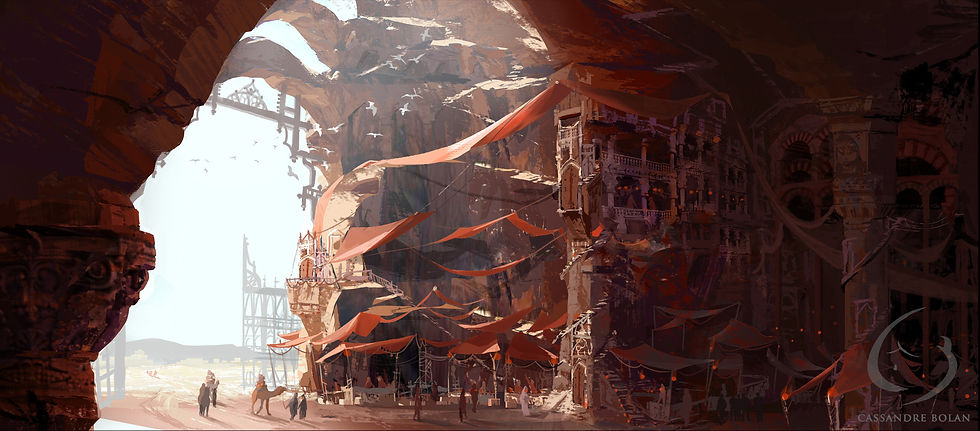
The land of fate is a world of extremes: mountains, deserts, jungles, and seas. The lands of Zakhara are a true melting pot, populated by men and women from a myriad of races. Generally speaking, zakhara lacks the racial prejudices of less civilized realms. Lifestyle, not race, defines and divides The land of fate. Silks and colorful robes are the trademark of the Empires of the Sands as are embroidered vests, turbans, and thick, curving swords tucked into wide belts.


The Lost Ship of Fate
Everyone in the Heartlands of Zakhara, and anyone who visits a tavern elsewhere in the Land of Fate, too, has heard of the "Lost Ship."
The tales told of it are many, colorful, and contradictory, but all agree that for years it has been sailing the skies of the Zakhara, hither and yon, flying low and silent yet never seeming to run into trees, the spires of tall keeps, or mountainsides.
Some say it's a trap for spellcasters, a lure whereby wraith-wizards of ancient days, who haunt it, drain the lives or possess the bodies or steal the spells of any mages foolhardy enough to venture aboard. Others say it's a haunted ship of insane, despairing undead who endlessly flee something even more terrible that pursues them through the skies. Still others believe it's a disguised crèche for dragon eggs, girded about with spells to snare and capture adventurers to be food for hungry hatchlings. Or it may be the abandoned home of a god, or a huge sentient monster masquerading as a ship, or a magical temple stolen from its rightful place by now-cursed thieves, now adrift in the skies. Some say pirates dwell aboard, dropping down on long lines to raid and plunder, only to be picked up again tendays or months later. There are almost as many tales as there are tellers, each one wild and strange, yet . . . fascinating.
From time to time, creatures find various ways aboard the Lost Ship.
Some are whisked there by magic (it seems a favorite destination for teleports gone awry), some arrive (or depart) through portals that seem to open and close at random (several tales insist that wraith doorways lurk in the Lost Ship, waiting to be revealed by a passenger who casts the wrong spell or bears the wrong item), and some leap or fall onto its decks from high places. Some have even been known to swing on ropes or vines to reach the decks from nearby loft perches, and many passengers aboard have successfully let down ropes to others (who may be dragged along, suffering much harm from ground obstacles, until raised high enough) to lift them, or allow them to climb, aboard. There have even been tales of beings who were asleep in their beds, who dreamed of the Lost Ship, awakening to find themselves standing on its decks!
It follows that the Lost Ship can provide uncomfortable transportation across truly inhospitable regions of the Zakhara, serve as "free" long-distance transportation, and even be a base for brigand raids or a home to those who don't care where they are in the Zakhara (such as scribes, limners, or cartographers desiring privacy for work). Inventors and spellcasters are warned that although the vessel provides a good environment for concentration and study, experimentations that involve unleashing magic or attacks upon the physical fabric of the ship (such as cutting ends of rope, or cutting or prying deck boards) seem to trigger ways to expel those experimenting from the ship. For instance, portals open beneath their feet, monsters appear out of nowhere to attack them, their own spells go awry to affect them, or they "fall through" one level of the ship at a time, subsequent falls occurring only if they persist in their activities. (The three successive falls are as follows: deck to hold, hold to bilges, and bilges to the ground below.)


Role-Playing:
Zakharans pay very close attention to the potential profits that an investment of time or effort will bring them. However, life in Zakhara is chaotic and these characters have learned to accept that. The weakness of a Zakharan is leisure time—they cannot get enough of it. Zakharans are not lazy, but they do try to make their duties easier whenever possible. Magic is a source of fascination even among Zakharans. Their expressions of wonder and delight appear odd in contrast with their martial demeanor.
Zakharans are also heavily influenced by their ancestral traditions that their people immigrated from the Elemental Plane of Air. They are generally very respectful toward natives from this plane, such as djinn.
Finally, Zakharans have huge, overbearing egos. To them, all that is good in civilization comes from Zakhara. And naturally, Zakharans are superior in all ways to people from any other inferior places in the Realms!
Races and Cultures:
In the Land of Fate, people fall into one of two broad groups: nomadic or settled. The nomads, or Al-Badia (ahl-BAH-dee-ya), are those who dwell in the hostile deserts of The Lands of Fate. They are tough, loyal to their blood-relatives, and constantly in search of basic necessities: water, food, and grazing land for their herds. The need for trade brings the Al-Badia into contact with the "other half" of Zakharan culture: the Al-Hadhar (ahl-HAH-dar), whose lifestyles are based in and around settled communities. Those who are permanently settled -- the people of the towns and villages who never move from their dwellings, are not Al-Badia. Artisans, merchants, craftsmen -- all are Al-Hadhar.
Al-Badia and Al-Hadar are different, but like two branches of a tree. They share a common culture, language, and code of ethics. They prefer to judge a person on his or her merit as measured against the basic beliefs of honor, family, hospitality, purity, and piety. Al-Badia and Al-Hadhar coexist peacefully because both groups understand and respect these same beliefs.
Religion:
Religion is a way of life among people in the Land of Fate. Honor is a matter of piety, of behaving in the manner deemed good and right by those who rule the heavens, those who will determine whether you are worthy of finding paradise in the afterlife. A dishonorable man, it is said, is never worthy of this great reward. Most of Zakhara accepts people whose religions are different. To believe in other gods may seem strange, but it is not a sin. The sin is believing in nothing.
Major gods, recognized throughout Zakhara, include Old Kor, Learned Zann, Brave Hajama, Najm the Adventurous, Selan the Beautiful Moon, Jisan of the Floods, Haku of the Desert Winds, and Hakiyah of the Sea Breezes. None of these gods has a precise portfolio. Instead, each shows strength in a particular ideal or element, wisdom, knowledge, bravery, courage, beauty, bounty, freedom, and honesty.
These Zakharan deities also include a plethora of lesser gods, local gods and demigods. Such minor deities may be venerated in one small area, while they are unknown just ten miles away.
The Campaign:
The campaign will take place (at least initially) in the Free Cities - A collection of independent city-states lining the inner sea of The Lands of Fate, each located at the mouth of a river. These cities have come to operate more independently than others who swear fealty to the Grand Caliph. In fact, the loyalty of the Free Cities (and their rulers) to the Grand Caliph is directly proportional to their distance from the armies of Qudra, a mamluk-run city that is a bastion against incursion into the heartland by northern barbarians.
With savage tribes to the south, wild pirates to the north and west, and western foreigners filling their streets, the somewhat uncivilized bent of the Free Cities is not surprising. Main products of the Free Cities include clothing, rice, agates, semiprecious stones, pottery, coffee, indigo dye, purple cloth and clothing, and trade in northern goods.


© 2020 by Not Quite Mentally Stable Minds.